Sunday, 12 July 2015

"I love you just the way you are"

This is getting to be a silly habit, but I'm going to stick to it for now - using song titles for my blog posts.

"I love you just the way you are" -  a Billy Joel love-song, but I refer here not to a person, but to Wimbledon, which reaches its 2015 climax this weekend. 

It's been another great tournament (is it ever not?) and mouth-watering finals still await us as I write. The top players have entertained us richly, the sun has shone, the venue has looked picture-perfect and players have, in the main "met with triumph and disaster and treated those two impostors just the same", as Kipling's poem reminds them to do in the Centre Court locker room.  The BBC's coverage has been comprehensive and authoritative, once they realised that viewers don't want the third-rate zoo-format of "Wimbledon 2day" that looked as if it had been devised by Siobhan Sharpe's fictional Perfect Curve. The Royal Box has featured a succession of celebrities behaving with impeccable discretion. It's so refreshing to see celebrities conforming to dress and behaviour codes rather than feeling the need to show off: David Beckham's look of gracious embarrassment when he so coolly caught that stray ball was a perfect example.

But then there was Australian Nick Krygios, this year's pantomime villain, who decided not only to revive the outdated tradition of bad behaviour on court, but also saw fit to question Wimbledon's "all white" dress code. Similarly, Canadian Eugenie Bouchard appeared to have a black bra strap (Quelle horreur!) on show during her first-round defeat against China's Ying-Ying Duan. There has also been controversy this year about players' use of prominent headphones, presumably with appropriate payment from the manufacturer, when walking onto court.

So is Wimbledon too stuffy? Current Wimbledon rules even state that any medical supports or equipment also have to be completely white unless it is absolutely unavoidable, and that no trimming on white shirts, shorts or tracksuits can be wider than one centimetre. Even Roger Federer, in many ways the epitome of the good grace and impeccable manners which are so cherished at the All-England Club, has suggested that the all-white rule has become even stricter during his time on the circuit, evoking images of Borg, McEnroe and Edberg with prominent trim in other colours to support his case.

Perhaps he has a point, but I cannot help but think that Wimbledon's enduring appeal to tennis players and fans, as well as to the many who pay no attention to sport of any kind for the other 50 weeks of the year is due in no small part to its insistence on apparently trivial matters of dress and protocol. In so doing, Wimbledon has remained immune to all but the most subtle of changes in appearance over a period in which all other major sports have become unrecognisable compared to  a few decades ago, largely because of the influence of advertising and sponsorship.

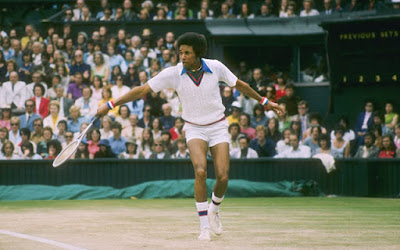
Look at this picture of Wimbledon winner Arthur Ashe from 1975:

and this of Roger Federer from 2015:

It looks as if Federer has a point about the use of colour trim having diminished, but most striking is how the scene has barely changed. No sponsors logos, no courtside advertising, then or now. Still the same Wimbledon green, same grass court, even the spectators look similar (OK, the scoreboard has changed)

Now let's try a similar comparison involving some other sports: 

Football 1970 - plain, baggy long-sleeved shirts, plain black boots, plain white ball, no pitchside advertising, muddy, sandy pitch (and that's Wembley!) The referee looks like a public schoolmaster.
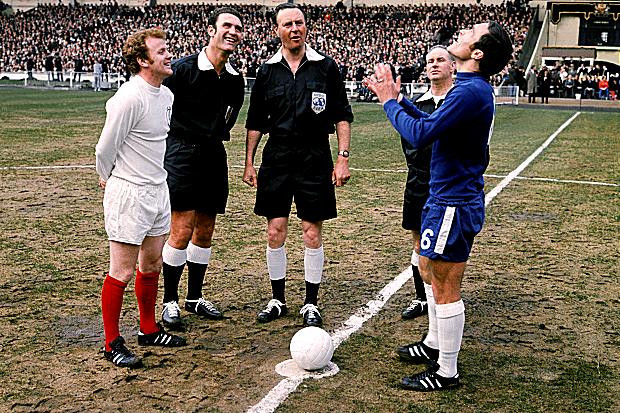

Football 2015 - tight short-sleeved shirts with sponsor logo, electronic pitchside advertising, yellow patterned ball, coloured boots, snooker-table green pitch.


Rugby Union 1970's - baggy shirts (now only worn as part of a Fran Cotton leisurewear collection!), old-school button-up rugby shorts, rolled down socks, brown ball, long grass.


Rugby Union 2015 - tight shirts with sponsor logo , leg strapping, protective headgear, snooker-table green grass.


Cricket 1970's - whites, caps - that's about it! The village green and the test arenas were no different..


Cricket 2015 - is this actually the same game?


Athletics 1976 - These women (800m Final at Montreal) look like the mums' race at a school sports day!


Athletics 2012 - unrecognisable as the same sport - several tenths of a second gained no doubt due to lost wind resistance!


Rugby League 1970's - you can almost hear Eddie Wareing saying "up and under"


Rugby League 2015 - Eddie is probably spinning in his grave!


OK, so I have chosen carefully to make my point, especially with the cricket ones, but I think these images show how the look, and therefore more importantly the "feel", of these sports has changed beyond recognition in around 40 years.

So what about tennis? Hasn't that changed too? Of course it has - like all big-time spectator sports, it has suffered, but also hugely benefited from commercial influence and the demands of TV companies. Wimbledon itself is a dream ticket for corporate hospitality, and if you look carefully, the players are in their own way walking advertising boards, albeit within the strict guidelines of the All-England Club. Look at Federer himself in his own brand of RF kit for very real, if subtle proof!

However, Wimbledon alone seems to have succeeded in not selling its soul to the corporate dollar. Only the most subtle of advertising is visible, making all the other grand slam tournaments look trashy. IBM, Rolex, Robinson's and Slazenger are all there, but only in their logical places associated with what they do. No Mercedes badges on the nets here!

But then there's the "all white" dress code. Does it matter? Yes, I think it does. It provides that air of timeless class that is so much a part of the global appeal of Wimbledon. Let it slip, and much else would be lost. For proof, look no further than the French Open. Here is a picture of Bjorn Borg playing winning there in the 1970's:


Basically, the same all-white kit that he wore at Wimbledon in those days. (and by the way, the courtside advertising was already dominant and intrusive!)

And now here's the 2015 French Open winner Stan Wawrinka, looking like a middle-aged holidaymaker just back from the beach for a quick game of tennis at the hotel:


I rest my case. Heaven forbid that Wimbledon ever lets him, or anyone else, dress like that. "Don't go changing...we love you just the way you are"


Friday, 3 July 2015

"My future in the system was talked about and planned" - musings on university open days

I enjoy finding suitable titles for my blog posts from song lyrics. This one comes from a 1973 song "Free Electric Band" by Albert Hammond, an under-rated English singer-songwriter best known as the writer of "When I need you", a UK No1 for Leo Sayer in 1977, and "The Air that I breathe", a UK No2 for The Hollies in 1974.
 
Albert Hammond, although English, moved to America, and some of his songs reflect that. "Free Electric Band" is a (rather late) manifesto of hippy-trippy dropout values in conflict with what used to be called "the system". It describes the writer's rebellious rejection of his parents' American middle-class values, and of their plans for a prosperous, conventional future.
 
This song came into my head yesterday when I spent a day in Oxford, as I always do at this time of the year, with  a small group of Sixth Form students from my school. At a university Open Day, especially at places like Oxford, young peoples' "future in the system" is indeed being "talked about and planned" Sometimes, I suspect, without their full cooperation.


I am very proud of the fact that, as a Higher Education Advisor, I have always made a point of taking a group of high-achieving students to the Open Day at my former university. I enjoy taking them to see my own college, showing them where I was lucky enough to live and study for three years, and hopefully inspiring and encouraging them to try applying if they are good enough.
 
 
When I first started doing this, over twenty years ago, Open Days were very different. On the way down to Oxford, one would see many school minibuses on the motorway, each carrying a dozen or so Sixth Formers, driven by relaxed-looking teachers enjoying a day away from the classroom at the end of term. Once in Oxford, groups were shepherded around by those teachers in much the way that I still do. They took their groups to a college Open Day, left them to meet tutors and current undergraduates, and went off to wander round Oxford for a couple of hours in the sunshine. That is precisely what I did yesterday, and do every year.
 
Sadly, the nature of the Open Day, and of those who attend it, has changed out of all recognition in recent years. Instead of groups of Sixth Formers enjoying the chance to chat informally with a teacher as they walk amidst the dreaming spires, the city is now crammed with embarrassed and mildly resentful-looking teenagers each with one, and often two, over-bearing parents looking for all the world like those who accompany their primary aged children to the now ubiquitous school open days. 
 
It's like what you see at any touristy cultural hotspot in summer: middle-class parents attempting to interest a slightly bored teenager in a cathedral/museum/stately home/visitor centre, with the said teenager actually wishing that s/he was lying on a beach listening to music on their headphones whilst catching up with Facebook, or riding a roller coaster at a theme park.
 
But at a university open day, it's worse than that. The childrens' future in the system is indeed being talked about and planned, and I have a terrible feeling that in many cases, the parents' desire to secure Oxbridge entry for their child is rather stronger than the child's desire to be there. I feel so sorry for the university tutors who are desperate to engage with these undoubtedly fine and capable young people and encourage them to ask the questions that they want to ask. Instead, they find themselves having to fend off questions from over-enthusiastic, vicarious parents. Fortunately, colleges and Departments have the sense to exclude parents from the subject sessions with tutors, and in some cases they put on a separate talk for parents.
 
Of course it's not quite as bad as I am painting it. It is perfectly reasonable for parents to take a teenager to an Open Day, and see for themselves what university life and work is all about, especially when there is a £30000 - £50000 price tag attached. However, I really do mourn the decline  of the school-led visit. Back in the 1970's, I applied to Oxford for a lot of reasons, but strongest among them was that I had a really good and inspirational French teacher at my (free, state) grammar school who was an Oxford graduate. He was clearly very clever, but also very funny, and he used to regale us with stories of his university days. I wanted to be like him, and was lucky enough to be able to fulfil that ambition. I know several of my friends from those days who applied to university for the same sort of reason.
 
Sadly, Oxbridge graduates don't seem to go into teaching as much as they used to. Small wonder, when they can command massive salaries in the world of business or commerce. With fewer Oxbridge educated teachers to inspire them, it is increasingly left to parents to push bright teenagers towards the glittering prize of a place at the top universities. Add to that the fact that school trips are now so hard to organise in terms of bureaucracy (did I remember to do a risk assessment before taking four seventeen year olds out on a punt yesterday?) that teachers understandably pass the task of open day visits over to only-too-keen parents. But what happened to the idea of sending a seventeen-year old off on the train, alone or with some friends, to a university visit. Surely that small step towards independence is a good thing?
 
I know, we can't rewind the clock. Times have changed. Universities, even Oxford, have to sell themselves, and that includes to anxious parents. They do a damn good job too - the Oxford Open Day is a masterpiece of logistical organisation and teamwork across a very devolved institution. But maybe, just maybe, parents should learn to take a step back. Take your kids to the Open Day by all means, but why not drive your son/daughter and a couple of mates, drop them off somewhere, go and do a bit of shopping, sightseeing or chilling, and arrange to meet up with the kids a few hours later for a good meal and a de-brief. That's exactly what I did yesterday, but as a teacher.

I bet, indeed I know, that university tutors would prefer it that way too.


Saturday, 13 June 2015

Club Day: what on earth is that?

Twenty nine years ago, on June 12th 1986, I moved to my present home, on the edge of the small market town of Kirkham, in the Fylde District of Lancashire. I had been working at the town's historic grammar school for five years, so I knew a bit about the town but only as a workplace and the end of a long daily commute from Southport.

Having decided I liked the school and secured a promotion to Head of Department, we had decided that it was a good moment to move closer to my work, with my wife having chosen to be a full-time mother to our one-year old daughter and new additions to the family planned.

We moved in on a scorching summer Thursday (the day after Gary Lineker's life-changing hat-trick in England's 3-0 win over Poland in the Mexico World Cup), and I had to return to work the next day, leaving my poor wife to start sorting out the chaos of our possessions dumped in a new house. 

Mid morning, she went to the shops to get a few essentials, accompanied by her Aunt, who had driven over from her home near Wigan to see our new house and lend a hand with settling in. With baby Felicity in her buggy, it was a chance for a bit of fresh air and a change of scenery.

On the short walk into town, they met an old gentleman in a flat cap leaning on his garden gate. "Ready for tomorrow are thee?", he enquired of the harassed young mother, curious Aunt and fretful child. My wife politely smiled and said yes, she was indeed ready for tomorrow, wondering why a complete stranger wanted to know of her readiness for the morrow. Was he mistaking her for someone else? Was he a fundamentalist zealot believing the next day, June 14th 1986 to be the dreadful day of judgement? She smiled politely, confirmed that she was indeed ready, and went on her way, wondering what manner of salutation this could have been.

The next day was Saturday, and we had arranged to return to our old house in Southport to pick up some plants in pots from the garden and to collect our cats, Buster and Bandit, from the boarding kennels where they had stayed during the move. So with baby Felicity dressed, ready and strapped into the child seat, we set off to Southport, but were startled to find our route blocked by an officious-looking policeman, who informed us that the road would be closed until midday at least - "for th'parade". The parade? What parade? We turned tail and went to Southport by another route.

That evening, on our return, we were again held up by the police while a parade went past, this time with a now tired and screaming baby and two howling cats who had pooed in their basket. We waited for almost an hour, and cursed this wretched thing called "Club Day", for it was indeed Kirkham Club Day which had caused all these mysterious and inconvenient goings-on. We were far from impressed, to say the least.

So why is it that, 29 years later, I think that Club Day is one of the best things about Kirkham? Well, I suppose it's because after 29 years (or actually after only a couple of years), I have realised that this quaint and apparently anachronistic event is in fact a unique and precious feature of this unpretentious little town. 

The year after we moved in, friends who had lived in the town for many years invited us to watch the morning "Procession of Witness" from outside their home which lies on the route of the procession. We were by then members of the congregation of St Michael's Parish Church, but we had been wary of invitations to join the procession, fearing that it was perhaps some sort of evangelistic attempt to draw more people into the church. But we watched, intrigued, as a huge and impressive parade of people of all ages and classes, some dressed in their finery, others not, took over an hour to walk past, accompanied by several marching brass bands, with splendid banners held aloft by burly men, the strings held by girls and women in matching dress. It was the scene so lovingly described in Blue Mink's 1971 hit Bannerman, and it reminded me of similar events that I had experienced as a child in Bolton, but which had long since died out.

What we did not yet fully understand was that the Club Day Procession of Witness  is in fact nothing more than a chance for the men, women and children of the five Christian Churches of the towns of Kirkham and Wesham to dress up and walk round the town, led by their clergy, watched by literally thousands of others who line the streets in warm-hearted support. The rest of the day is spent eating, drinking and being merry in the invariably fine June sunshine, with the town's park hosting a traditional travelling funfair, the pubs doing a roaring trade and the suburbs pervaded by the aroma of barbecues as families and friends come together in a manner repeated only at Christmas.

As our children grew, they were involved in the Procession in a variety of roles and guises: as brownies, guides, beaver scouts, cubs, flower-girls, Rose Queen attendants, Rose Queens and choristers. For my part, I have carried banners, supervised children, marshalled the route and now act as marshal for the St Michael's Church part of the procession, responsible for ensuring that everyone finds their right place in the order, that nobody gets hurt or left behind, and that we take our allotted place in the overall order amongst the other churches.


Walking the 3 mile route is a truly uplifting and life-affirming experience. Just consider this: over in Northern Ireland, now thankfully largely free of the sectarian violence which scarred that community, it is still the case that when different denominations of the Christian Church parade, they must do so out of sight of others and with due sensitivity to the religious affiliation of the neighbourhood, for fear of sparking violence. Here in Kirkham, as the Anglicans pass the Catholics, we greet each other with friendly banter about dresses, sore feet, and secret stashes of alcohol (the Catholics allegedly secrete suitable liquid refreshment amidst the flowers at the feet of their portable statue of the blessed virgin Mary), whilst the rival bands attempt to out-blast each other as the sound of hymn tunes echos off the walls of the Lancashire terraced houses that line the streets. To watch this procession is truly to see the church as a unifying force for good in a diverse and friendly community, many of whom are proud working-class folk whose families have lived in the town for generations.

 "Club Day" has a long and interesting history, unique to the Fylde district of Lancashire. It is rooted in the 18th century "friendly societies", or "clubs", which were set up to support the needy in these poor communities in the days before the state could do so. Once a year, the societies would parade through the towns in celebration of their existence and work, and the day evolved into a community carnival, with the churches becoming involved, it is believed, to moderate a tendency towards excessive drinking.

The friendly societies have long gone, but far from dwindling or even dying out, as religious processions such as the Whit Walks in other Northern towns have done, Kirkham's Club Day has prospered and if anything grown in size and scope over recent years. The day used to feature a secular evening Carnival procession (the one which held us up on our return home that evening in 1986), but this died out some years ago through lack of support for the groups who organised it. Meanwhile, the religious "Procession of Witness" continues to attract hundreds to walk the streets in unashamed support for their churches, and thousands more to stand, watch and support their friends and neighbours. It is Christian witness worn easily, unselfconsciously and joyfully in a manner that reminds the towns that the church is still a strong cohesive presence in the busy life of the communities it serves. More importantly, it reminds those who walk under the banners of different shades of the Christian faith that what unites them is far more important than the minor differences of emphasis which divide them.

Long may it continue!

Sunday, 17 May 2015

"Die heilige Cäcilie oder die Gewalt der Musik"

What's this about? What's with the German title?
Well, these words have been in my mind over another wonderfully successful meet-up of the three  twin towns, Kirkham, Ancenis and Bad Brückenau over last weekend, May 15th - 17th. "Die heilige Cäcilie oder die Gewalt der Musik" is the title of a short story by the  18th/19th century German writer Heinrich von Kleist. I studied his work as part of my degree at university many years ago. It's a weird and disturbing tale: I can't remember much detail, but the title refers to St Cecilia, traditionally the patron saint of music and "the power of music", and it's that idea that is my blog post theme.
It's not a remotely original idea, but music is a truly powerful thing. This has been vibrantly apparent over this past weekend in Ancenis, as I have had the pleasure of  being present at the meet-up between the bands of our French and German twin towns. Each of these towns, small provincial communities of around 8000 inhabitants like Kirkham, has a municipal band consisting of ordinary people, who share a love of making music. The two bands are both what we would call "concert bands" - brass, woodwind, and percussion  - and crucially, their members are a mix of genders, ages and social classes. Both bands are directed by young men, and both sets of players give every indication that they simply love making music. When these two bands come together (and like their towns, they are  formally "twinned"), it illustrates very powerfully that music is a common language with the power to transcend boundaries of language and culture. Their repertoire is in both cases mixed, but very much drawn from international common culture, notably from popular classics and anglo-american light music. The two bands clearly enjoy and appreciate each others' work, and frequently play joint concerts, led by one or other conductor, and to witness their work at such times is truly life-enhancing. The common language of music means that they have so much more in common than what divides them.
There is, however, a sad side to this: the lack of an English equivalent. Kirkham has no town band and is frankly unlikely to have one in the foreseeable future. Why is it that a country with our love of music, our artistic talent and creativity, does not foster a culture of music-making in our communities? I don't know the answer, but I have to wonder whether it is a consequence of our education system, which does so much to encourage and value the arts and other extracurricular activities as a big part of how we educate our children. Every British school, primary or secondary, state or private, prides itself on the breadth and quality of what it offers its pupils - look at the website of any school and you will see as much about sport, music and drama as you will about the academic curriculum and exam results. French and German schools pay lip service to the arts and sport, but do not boast anything like the provision that even a poorly resourced school in the UK can demonstrate, and this means, I suspect, that it is outside of school that young people in those countries pursue such activities. Difficult to say which way is better, but I would point out that a crucial disadvantage of the UK model is that it limits severely what people can do after leaving school, and just perhaps fosters an attitude that music, drama and sport is something that kids do at school, watched and admired by their parents, but then "outgrow" as they move on to do more adult things.
I feel really bad saying that, because I work in school which has a wonderful tradition of  sporting, dramatic and musical excellence, and I cannot imagine my school without these excellent activities, but I do wonder whether we in Britain are too dependent on our schools to foster artistic and sporting talent. Like so much else in life, I guess there must be a happy medium, because everything I see and hear about schools in France and Germany makes me value and cherish the "educating the whole person" culture which is so central to the British system. I remember a French national whose son was at my school praising the "polyvalent" nature of the English system which had given his son the chance to sing a Haydn mass, play rugby and act Shakespeare all in one year at the age of 12. Perhaps we in the UK should look at how we encourage  our young people to move on from what they do at school. And especially in music, maybe we should encourage parents and other adults to play with and alongside their children, rather than just standing and watching.

Speech at 2015 twin towns gathering in Ancenis

This is the text of the speech I gave to  the gathering of people from our three twinned towns on Saturday 16th May 2015. It speaks of the precious thing that is friendship across borders.

"Mr Mayor of Ancenis, Madam Mayor of Bad Brückenau, ladies and gentlemen,

It is with great pleasure and pride that I speak for the first time as President of the Kirkham Twinning Association at a visit to one of our twin towns. I also have the pleasure of bringing greetings from the Mayor of Kirkham and the Town Council: you will be aware that we in Britain are in the midst of our electoral process at both local and national level, and so our council representatives are unable to be present here in Ancenis on this occasion. We are delighted to have with us Mrs Sheila Hardy, whose husband Councillor Peter Hardy has just been elected as Mayor of Fylde Borough, our municipality. It is a great honour for Kirkham that one of our Councillors has been elected to this role, and Peter will be formally installed as Mayor at a civic ceremony on this coming Wednesday. It is particularly pleasing for those gathered here today to know that Peter is a loyal and enthusiastic member of the Kirkham Twinning Association. May I ask the people of our three twin towns to join me in wishing Peter a successful year as Mayor of Fylde Borough Council.

We meet here in Ancenis at a time of poignant anniversaries: a hundred years since the First World War and 70 years since the end of the Second World War. All of us gathered here now are too young to remember those two conflicts between European neighbours, but the legacy and memories of those dark times for our continent are still very much with us, not least as we mark these anniversaries.

Let us therefore rejoice in the fact that we meet every year in one of our towns as friends and partners. I have recently been editing my grandfather’s autobiography, and reading with sadness how almost exactly a hundred years ago, he travelled to France as a young man to fight in that futile conflict. He survived, where thousands of English, French and German young men did not, but he, like so many of his generation, was saddened to find Europe at war again just twenty years later.

How lucky we are, and how precious it is, that in our generation, the peoples of our three towns meet not to fight, but to share fellowship, food, drink and culture. How sad it is that there are those in our three countries who seek to undermine the European project, but we must not let those voices prevail.

So it is with great pride, passion and enthusiasm that I say “Long Live Twinning!”

Tuesday, 12 May 2015

Nothing's gonna stop me #DBlogWeek

Just wanted to add my own quick post for #DBlogWeek. I haven't got much time to write at length or in a considered manner, but I just wanted to add my bit to this week and an obvious title is "Nothing's gonna stop me"

Not a very original title, in fact partly plagiarised from the title of an 80's power ballad classic by Jefferson Starship: Nothing's Gonna Stop us Now. Now there's an uplifting, mood-enhancing song. I defy anyone not to feel a bit better after hearing that!

But why that title now? Well, this time tomorrow (it's now Tuesday 12th May) I will be on board a ferry to St Malo, France, having driven down from Lancashire to Portsmouth. I am headed for Ancenis, the French twin town  of my home town.  As President of the Kirkham Twinning Association, I am leading a delegation from Kirkham attending a meet-up for Ascension Day weekend (a public holiday in France) together with our friends from Bad Bruckenau, the German town which is the third partner in our unusual three-way twinning arrangement.

Twinning is the subject for another blog, but for today, I just think it's a good moment to point out that Type One diabetes hasn't stopped me doing what I want to do in life - like driving to the Loire Valley in France and back as leader of a twin town delegation.

Of course, it's much more hassle travelling with diabetes. Packing and preparation for this or any journey involves planning and checking, since to forget insulin or blood testing equipment would be pretty disastrous.

But beyond that, it's perfectly possible. Over the coming three days, I will be attending events involving food and drink, possibly unpredictable and irregular, as well as helping translate and liaise between the peoples of these three towns. I will even be making a speech which I have had to write in three languages.

Plenty of opportunities there for diabetes to trip me up, but with sensible planning, good supplies of jelly babies and biscuits, as well as all the necessary medical stuff, I should be fine. I will also be accompanied by my faithful travelling companion for such trips, my (adult) daughter Rosie.

In other words, nothing's gonna stop me. Twitter followers will probably see some highlights of the weekend on my Twitter or a new one I've set up for the Kirkham Twinning Association 

So, for now, "Goodbye, Au Revoir, Auf Wiedersehen"

Saturday, 2 May 2015

That was then, but this is now...

On May 15th 2005, I was among 27000 supporters at the Reebok Stadium as Bolton Wanderers signed off a successful season with a 3-2 defeat of Everton, qualification for Europe and a 6th place finish in the Premier League, English football's top tier.

Today, ten years later on May 2nd  2015, I was among 18000 supporters at the same venue, now the Macron Stadium, as Bolton Wanderers signed off an unsuccessful season with a 1-0 defeat to Birmingham City, and an unexciting 18th place finish in the Championship, English football's second tier. 

At the end of both games, the players and their families did a lap of honour, as is now traditional in football, with fans given the opportunity to show their appreciation of the players whose wages they help to pay. 

There, the similarity ends. 


Bolton v Everton, May 15th 2005
May 15th 2005 was one of those glorious end-of-season days, with shirt-sleeved fans lapping up the Spring sunshine, and looking forward to the prospect of the club's first ever European campaign. The players being applauded round the pitch on that sunny afternoon included Spanish icon Fernando Hierro, the late great Gary Speed, Greece's Euro 2004 winner Stelios Giannakopoulos, the talented but temperamental talisman El Hadji Diouf and the outrageously gifted Nigerian Jay-Jay Okocha, as well as English workhorses Kevin Nolan and Kevin Davies. Glitter cannons showered blue and white confetti all over the pitch as the PA system blasted out the Bolton fans' song of the year, "Is This the Way to Amarillo?", made famous that year by local comedian Peter Kay's Comic Relief version. It was truly an exhilarating time to be a Wanderers fan: "We're all going on a European Tour" was gleefully sung to the tune of "Yellow Submarine", and sure enough, the following year, fans of unfashionable Bolton Wanderers were following their heroes to Bulgaria, Turkey, Portugal and France. I myself, with my son, travelled to the iconic Stade Vélodrome in Marseille as Wanderers exited Europe at the first knock-out stage the following February. Two years later, in a second European campaign, Wanderers famously held the mighty Bayern Munich to a 2-2 draw at the Allianz Arena. We perhaps didn't fully realise at the time how lucky we were.

Bolton v Birmingham City, May2nd 2015
May 2nd 2015 was, by contrast, a cold, wet day. A patched up Wanderers team, including academy graduates so unfamiliar to even regular fans that we were scouring our programmes to find out who they are, battled gamely in a meaningless end-of-season fixture, losing without ever looking outclassed, but without ever looking anything like good enough to win. At the end of the game, with only a small proportion of the crowd bothering to remain behind, the players and their families took a brief and somewhat sheepish lap of honour, to applause which was, if anything, sympathetic in tone. Instead of superstars of the world game, they were a mixture of fresh-faced academy graduates, promoted to the First Team to fill in for injured regulars, and loan signings from clubs where they were surplus to requirements. The two most recognisable faces were burly veterans Emile Heskey and club legend Eidur Gudjohnsen, both possibly playing their final games for the club having been drafted in by manager Neil Lennon to bolster a threadbare squad.


The contrast between these two days was stark, and glaringly illustrates the roller-coaster fortunes of any football club outside the Premier League's true élite. That 2005 match was played in a packed and raucous stadium, with the game featured that night on "Match of the Day", its result and significance prominent in the next day's newspapers. The pre-match buzz in those days saw crowds of fans gathered around the Stadium's front entrance, invariably catching a glimpse of famous faces - former players, pundits, celebrity fans and the like. Today, the pre-match atmosphere around the ground was good natured enough, but bleak and subdued. The Birmingham fans, present in good numbers and excellent voice, provided a touch of noise, fun and humour with their traditional end-of-season fancy dress (I saw, amongst others, a duck, four Teletubbies, a carrot, a surgeon in a blood-stained operating gown and Jesus), but the feeling among Wanderers fans was one of "let's get this over with", after such a poor season.

It is clear to even a casual observer that our popular and respected new manager Neil Lennon has a huge job on his hands over the summer, rebuilding a team with some sense of pattern and stability on a very tight budget. There is much promise, both in the spirit and manner of play that we have seen at times under Lennon, and in the performances of some players: It is blindingly obvious that Adam Bogdan in goal and Mark Davies in midfield are the sole survivors of our Premier League days, so keeping them would be a good start. American Tim Ream, player of the year for the second year in succession, is also a class act. Striker Adam LeFondre also looks worth making efforts to sign permanently. Almost every other player in the squad has some sort of question mark over them, yet youngsters like Max Clayton, Josh Vela, Zach Clough and Tom Walker look to have a future. There are also injured absentees to remember, notably Darren Pratley, who was playing his best football since joining us when he got injured. 

But my overwhelming sense today was of nostalgia for a golden era under Sam Allardyce. In our eleven years in the Premier League, we saw most of the modern game's superstars at the Reebok, and quite often sent them home with tails between legs. The oft-repeated sight of an angry and frustrated Arsène Wenger on our touchline as his Arsenal were outfought (and more often than he would care to admit, outclassed) at the Reebok, is etched in the minds of all Wanderers fans from that era. And let us not forget that it was the much-maligned Gary Megson who gave us our only modern-era home win over Man United, as well as bringing to the club and nurturing  some wonderful talents such as Gary Cahill, Stuart Holden, Mark Davies and Chung-Yuong Lee.

Perhaps above all, today reminds me and other Wanderers loyalists that football is a metaphor without parallel for life itself, especially if you support a team outside the Premier League's  permanent élite. I hope that fans of the likes of Burnley, Southampton, Stoke City, West Brom, Swansea, QPR, Leicester, Hull, and now Bournemouth, Watford and whoever else goes up remember to drink it all in, because for many of them, their moments in the sun, like Bolton's in 2005, will be fleeting.

Having said that, I also genuinely believe in the psychologically therapeutic value of following a football team, especially a less successful one. Football provides an ultimately harmless mirror of life's ups and downs, and as such can serve as a useful and safe outlet for our emotions, be they good or bad. Having followed Bolton Wanderers through thick and thin for around fifty years, I can honestly say that they have given me a chance harmlessly to rehearse every emotion life can throw at me. And in so doing, I feel that maybe, just maybe, I can cope better with life's real ups and downs. 

Supporters of Bournemouth take note - enjoy it while it lasts. Not long ago, you were at the foot of football's 4th tier, and for all we know, you may all-too-soon go the way of Blackpool and Wigan, whose recent glory days must already seem a very long time ago. And as for me, yes, I didn't return home today full of the joys of Spring as I did back on May 15th, 2005. But I am looking forward to better times ahead. I'm just not sure how far ahead they are....

The Way We Were

“Can it be that it was all so simple then? Or has time re-written every line? And if we had the chance to do it all again, tell me... Would ...