Tuesday, 15 June 2021

"Walking on the Milky Way": some thoughts for Diabetes Awareness Week 2021


Some thoughts for Diabetes Awareness Week, to an extent recycling things which I have said before, but worth modifying and repeating, precisely in order to raise awareness. When talking about diabetes, I have always tried to strike the balance between melodramatic self-pity and “no big deal”. My talk at TAD back in 2017 attempted to put this across by portraying diabetes as “something and nothing” and four years on from that talk, and twenty three years on from diagnosis, that’s still my view. I genuinely find it hard to get annoyed by diabetes, or by others’ attitude to it; I am, however, very aware that for others this is not the case. I am sure that I would have found it far more of a burden if it had interfered with my carefree youth, or indeed if I hadn't had the benefit of the monitoring technology which we too easily take for granted. However, I am fortunate to be gifted with a temperament that doesn’t easily get annoyed, so for me diabetes remains a severe irritant rather than a burden. 

However, the one thing that consistently irks me in the perception of diabetes among those who don’t have experience of it is the widespread sense that Type One Diabetes is a condition that affects the young, which as I have written before, overlooks the fact that it can and does come on at any age, and that it stays with you for life.

I am resolutely anti-ageist: when I was young, I had many friends who were much older than me, and now that I am in my sixties, I have friends of all ages, including many in their twenties and thirties. I enjoy, but don’t crave, the company of others, and have always enjoyed most the company of people who are less than obviously like me. So I tend to find friends among those who have little in common with me, be it interests, occupation, tastes, gender or age. I believe that I am age and gender blind to a good extent, and I still feel no different mentally to the child, teenager or young adult that I once was.

However, in diabetes terms, I often feel compelled to draw attention to my age, given that persistent sense that the Type One Diabetes with which I live is often thought of as a young persons’ condition, whilst Type Two Diabetes is often associated with older age. Neither is true.

The theme for this year’s Diabetes Awareness Week is Diabetes Stories. Diabetes is a condition where there are as many stories as there are people living with it, but sharing stories is important, not least because others may read, recognise and draw comfort from similarities, and perhaps most importantly, because others may recognise symptoms and seek potentially life-saving help. My own story serves to remind others of the fact that Type One can strike at any age, and that once it does, it is there for life – a life which can and should be no shorter than anyone else’s. My story is a good illustration of the former, and I have every intention of ensuring that it proves to be a good illustration of the latter.

I was diagnosed at the end 1997, at the age of precisely 40. Until then, I had lived a life with minimal contact with the health service. I had the standard childhood illnesses, with the associated spells off school before the age of 10; I then managed an entire secondary school career without a single day's absence through illness. I fell off my bike at the age of 13 and suffered a straightforward arm fracture, which mended in the standard six-week time frame. And that was about it. Prior to my diagnosis with diabetes in 1997, I had worked for 17 years as a teacher with a total of about four days off sick (two lots of two). My doctor's surgery was a place unfamiliar to me.

Moreover, I was a slim, healthy and active person: as a child I had walked or cycled to school, played football as a recreation and spent holidays fell-walking with my family. As an adult I cycled to work, tended an extensive garden and walked from my home to the local shops rather than driving. And I still do.

Then, at the age of 40, I had a very bad case of 'flu - real ‘flu -  in the week running up to the Christmas break at school. A week's absence off work the first time ever, but no real cause for alarm: there was a big epidemic that winter (1997-98) and a number of colleagues were off at the same time. Then, on the day after I had started to feel better again, my condition took a nosedive, and I went to my GP, alarmed at this apparent recurrence of an illness from which I had just recovered. I felt tired, thirsty and run-down, but just thought it was a hangover from my first real illness in years. A routine urine test revealed very high blood sugar, and an alarmed GP informed me that she was pretty sure that it was diabetes, referring me to her colleague at the practice who was the specialist in diabetes. I was briefly thought to be Type Two, but with symptoms persisting and getting worse, it soon became clear that I was Type One, and my over-riding emotion was one of relief, not fear. I had found the cause of what, with hindsight, had been a malaise which had crept up on me through that autumn, with a battery of symptoms, all of which had been quite easy to explain away.

Foremost among these symptoms was the raging thirst. I had always been a thirsty individual, so the feeling of extreme thirst on hot days, after exercise, or after a meal was a familiar one. On a number of occasions that autumn, I therefore explained away extreme thirst by circumstances such as a salty snack, or a dash for a train on a warm afternoon. Moreover, it was in the late nineties that the sensible but now overstated and ubiquitous obsession with hydration really took hold. Not that many years ago, we didn’t all walk around clutching a bottle of water, and footballers played a full 90 minutes in the sunshine without taking hydration breaks. So if it doesn’t sound daft, thirst became fashionable in the late 90s, and I subconsciously bought into that fashion.

Another creeping symptom that autumn was extreme tiredness, but back in those days, my autumn working life was absurdly busy. As a Head of Sixth Form, it was the season of university applications which used to be submitted by an immoveable December 15th deadline, and with 100 or so applications needing detailed references, no administrative support and little timetable remission I did most of that work in my spare time before school, after school and through very long evenings. It was exhausting, so any possibility of it being exacerbated by a medical condition didn’t cross my mind.

And then there was weight loss. I was never overweight, but had like most people gained a bit as middle age encroached. But then I started to notice a bit of looseness in trousers, requiring one notch tighter on the belt, or shirt collars feeling a bit loose. Fair enough, I thought. Losing a few pounds around the 40th birthday was a welcome bonus, I thought, to being very busy and physically active, often with barely time for lunch or snacks.

Looking back, I was ignoring symptoms that should have rung alarm bells, but it took that dose of flu to bring it to a head. I assume that my diabetes came on gradually over those weeks, but that week’s illness gave it the boost that made it impossible to ignore. My HbA1c on the day of initial diagnosis was 22.1, and rose to 33.1 a couple of weeks later - just before I started on insulin. (I love that I can now look up those numbers on my NHS records)

The fateful numbers

Once the insulin started to have an effect (and that effect comes on almost instantly, as anyone with Type One will tell you), I was soon back to normal. By the Easter four months after diagnosis, I led my annual residential school trip to France with about forty pupils and five colleagues. I continued to do this every year whilst it remained part of my role at the school. By the June six months after diagnosis I was planning, setting up, organising and running the end-of-exams Ball for 200 Sixth Formers, a demanding job I undertook every year. In day-to-day terms over the remaining twenty years of my working life, I continued to take on all that life and work throw at me, with an unblemished attendance record in a very stressful job. I never missed a day due to illness through all that time.

But let's not pretend it's easy. Living with Type One Diabetes is a 24/7 challenge that we face on top of all as that we do in life, whatever that may be. You can never forget or overlook it for more than a few minutes. Every action, every piece of food or drink, every event needs to be thought through. Any departure from routine is potentially risky. Most infuriatingly, insulin - the treatment that you self-administer every day in order to preserve your life - is precisely what threatens to bring you down in day-to-day terms. I think is fair to say we have a love-hate relationship with it!

And please, if you're reading this and someone of any age whom  you know or love is showing diabetes symptoms - often now called the “Four T's” (thirst, tired, toilet, thinner) – do consider the possibility of Type One Diabetes. It is not at all related to lifestyle, diet or condition. It can strike at literally any age, not just in childhood and adolescence. And above all, it should hold no fears for the person diagnosed or their family. It will be a lifelong nuisance, which is fully controllable thanks to the wonders of insulin, increasing availability of sophisticated ways to administer it and very clever ways of monitoring blood sugar. And it won't stop you doing anything, eating anything or living a long, healthy and happy life.

If you are familiar with my blog, you will know that all my posts are given an appropriate song title, with a link to the appropriate song. My title is a song from my DiabetesPlaylist which I think is one of the most under-rated singles of the past few decades. OMD’s Walking on the Milky Way just about qualifies as a diabetes song in terms of referencing a chocolate treat which is NOT off limits for people with Type One, but for me it is a bitter-sweet recollection of lost youth tinged with dignified acceptance of the passing of time and creeping old age. It is melancholy yet triumphant, and this summer celebrates the 25th anniversary of its release in the iconic summer of 1996. A brilliant introduction, a fabulous bridge, a soaring chorus and an outro that sounds like a recessional organ voluntary. If you're old enough, it'll take you back to the summer of '96. And if you're not, a chance to get to know a fine song that you missed.

Wednesday, 14 April 2021

“The Land of Make Believe” – in which the late Shirley Williams became PM


I hesitate to write about politics here, but I have long since realised that the bubbles in which we live -  both real world and online - are very small, meaning that my posts are read largely by people of remarkably similar mind-set. I have therefore concluded that there is little risk of causing offence by breaking the traditional “no politics, no religion” rule. And in any case, there is only so much that can be said about diabetes without repeating oneself or others, so I have always taken opportunities to write about other topics, if only for the enjoyment I derive from gathering and expressing thoughts.

So here’s a piece about Shirley Williams, a politician whom I greatly admired, who died this last Monday, April 12th 2021 at the age of 90. One reason to write about her is that I have been forcefully reminded of the passing of the years by my recent Ruby Anniversary, which inevitably brought reflections on the world of 1981 and what has changed since then, so her death 40 years after her greatest fame was somewhat more poignant for me. Given that you have to be over 50 years old to have any clear direct memory of Shirley Williams in her prime, I hope that those who do not remember the events of the early ‘80s will be interested to read my perspective on those interesting days, particularly as I also had an indirect personal connection to her which may be of interest.

Deaths of the famous rightly provoke much reflection and retrospection; this week of all weeks in particular, as the passing of Prince Philip gave us a foretaste in “Operation Forth Bridge” of what will happen when we finally get to “Operation London Bridge”. On the whole I have appreciated and enjoyed the way in which Philip’s death has been marked, and whilst the haters have been rather too visible on social media, I think the vast majority of us recognise and understand that a remarkable man who achieved a great deal in an enormously difficult role deserved to be the subject of such attention, respect and even love.

But the less well documented death of Baroness Shirley Williams perhaps deserved greater attention. It reminded me that she was a politician whose contribution to recent history could perhaps have been much greater. The fact that I was obliquely connected to her through a mutual friend who was her mentor has given her death added significance for me.

She is certainly one of several “might have been” figures of recent political history, notably on the centre left, taking her place alongside Tony Crossland, John Smith, Alan Johnson, David Milliband and Ed Balls as people who had more to offer than political circumstances allowed, and who might perhaps have steered the country on a different course had they had the opportunity to become Prime Minister. Obituaries such as the one linked to her name above, or this from the Guardian rightly drew attention to her self-confessed shortcomings, but there is no doubt that she was for some years considered to be a potential Prime Minister.

So what was my connection to Shirley Williams? Well she was a close friend and protégée of my late family friend Margaret Higginson, who was Headmistress of Bolton School (Girls’ Division) from my mother’s time as a teacher there. Margaret was one of the leading educationalists of her time, a mildly eccentric, lovable spinster, a “schoolma’am” whom my mother had befriended back in the seventies by including her in many of our family events and outings, recognising that being an unmarried headmistress of such a prestigious school was in fact a lonely job, especially in the holidays. My mother popped her head round the door of the Head’s study on the last day of term and found the normally stoical Miss Higginson looking tearful, and when my mother asked if she was OK, she admitted that holidays were a lonely time for her. Mother invited her for tea a couple of days later, and she gladly accepted. Thereafter she became to me and my brother Chris an aunt-like figure, a frequent visitor to our home, an extra on family outings and a guest at our respective weddings. She loved serious conversation, and I remember her talking proudly of an ex-pupil named Shirley from her time teaching in London, who had become a Labour MP. Despite leading a traditional grammar school, which under her headship became an independent school rather than turning comprehensive, Margaret was a socialist intellectual, whose headship of Bolton School was characterised by constant reminders to the girls in her care that they were privileged to be at the school, and therefore morally obliged to give back to society both whilst at school and in their lives beyond it.

As Shirley Williams rose to prominence, becoming a Cabinet Minister under Harold Wilson’s third administration in 1974, I was always aware of her connection to Miss Higginson and I followed her rise to prominence with not only that personal interest but also with admiration for her manifest authenticity, her ability to connect to people and her espousal of moderate socialism.

Sadly, her cabinet career proved to be short-lived: a few years after her joining the Cabinet, the country had moved on in a contrary direction. Harold Wilson resigned out of the blue in March 1976, provoking enduring conspiracy theories, and his successor Jim Callaghan fell victim, like another unelected Labour PM Gordon Brown 30 years later, to a sense that he was a weak leader without the full authority of an electoral mandate. A badly-judged response by his government to public sector strikes in what became known as the “winter of discontent” of 1978-79 allowed the Tories under their new leader Margaret Thatcher to portray Labour as being in the pockets of over-powerful trade unions, and to perpetuate a narrative which has persisted to this day that the late 70s were a period of chaos and decline. My own memories of the period, and to a good extent economic, social and political data, beg to differ.

Nevertheless Thatcher was elected, and whilst the event was rightly heralded as a step forward for women’s rights, it was already clear that Mrs T was, as Spitting Image so cuttingly portrayed her, more like a ruthless, ideologically driven man in women’s clothing. I was living in France at the time, and on more than one occasion I had cause to caution ill-informed female French feminist friends who were excited by Britain’s taking a leap forward for gender equality by electing a woman Prime Minister. “Attention - du point de vue politique, c’est un homme” are words I recall uttering more than once to bemused observers.

I don’t think that history has proved me wrong, but for a brief period early in Thatcher’s reign, a very different woman, Shirley Williams, offered a tantalising glimpse of what a less dogmatic female leader could offer the country. In early 1981, with the country reeling under the effects of the first doses “Thatcherism”, by which what was now very clearly a radical right-wing government was seeking to roll back the power of the Trade Unions and the State with a degree of ruthlessness which, however justifiable some of her aims, was proving difficult for many - including me - to stomach. Unfortunately, the Labour opposition was doing what losing parties often do in response to heavy defeats, namely shifting to its own extremes under the worthy, admirable but unelectable Michael Foot. Interestingly, history repeated itself, as it always does in politics, when Labour under the equally unelectable Jeremy Corbyn handed Boris Johnson and Brexit victory on a plate in 2019.

However, in 1981, things suddenly got very interesting. Despairing at Labour’s lurch to the left, a new “Centre Party” was formed by a group of four ex-Labour ministers, David Owen, Shirley Williams, Roy Jenkins and Bill Rogers, who left their party and formed a new group, the Social Democratic Party. I was delighted: the SDP was a natural home for me, having long called myself a social democrat, not least because of my admiration for what social democracy had achieved in post-war West Germany. I was newly-married and by two coincidences the SDP story became entwined in our lives in a manner which was briefly exhilarating and exciting: Firstly, in autumn 1981 Shirley Williams bravely announced that she would fight the safe Conservative seat of Crosby, North Liverpool in a by-election caused by the death of the sitting MP. The newly-retired Miss Higginson - or “Higgy” as she was always known to us -  announced that she would campaign for her protégée, indulging her own lifelong moderate socialism, free of the need to supress her true political colours. Moreover, in her famously and lovably insensitive manner, she invited herself to stay with us in Southport, having realised that she could commute with my wife to Crosby throughout the final week of a campaign which was by then making national and international headline news.

Shirley Williams campaigning in Crosby, Autumn 1981,
flanked by Bill Rogers & David Owen

Then there was a second coincidence: a colleague of my wife’s, a young maths teacher named John Backhouse, was standing as the Labour candidate in the by- election. Backhouse was typical of the Merseyside Labour Party of the time, extreme left and with little grasp of the realities of life in Thatcherite Britain, but it quickly became apparent that Shirley Williams was a real contender, thanks to her erudite, eloquent, pragmatic and moderate policies and her engaging and caring manner. My wife’s school was very much a centre of activity during the campaign, and as Higgy came home every day with tales from the doorsteps of Crosby, we felt genuinely connected to a story that was causing so much attention. On the eve of the election, with a sense of a political earthquake in the air, we attended an SDP rally, accompanied by Higgy, addressed by all four of the now famous “Gang of Four”. It was a truly exhilarating event, with the feeling of a new political beginning very real. Shirley Williams duly won a decisive victory in what had been a rock solid Tory seat and for a few months, with unemployment soaring and Margaret Thatcher proving to be divisive and inflexible, it really looked as if this centrist force could consign Thatcherism to history as a short, failed experiment.

But then in April 1982, General Galtieri’s Argentinian Junta took the fateful decision to invade the Falkland Islands, giving Thatcher the opportunity to transform herself almost overnight into a latter-day war leader, dispatching a task force to an ultimately successful old-fashioned war with a frankly incompetent and ill-equipped enemy. The political tide turned, Thatcher won two more elections, transforming the UK forever, and the SDP died a long and lingering death. I had joined the party and done a bit of door-knocking and leafletting for the May 1982 local elections in Southport, but it was immediately apparent, even on the doorsteps of Birkdale, that Galtieri had unwittingly saved Thatcher.

Shirley Williams lost her seat at the next General Election, and remained a public figure of significant influence, as the many tributes paid to her have acknowledged, but never came anywhere near power again. As a peer, she exemplified exactly what members of the House of Lords should be, namely a wise old head and a mentor and advisor to younger, less experienced politicians of all persuasions. She was a frequent guest on shows like BBC’s Question Time, often as a nuanced voice of opposition to prevailing trends, and her lifelong pro-European views came to the fore during the grim years of national infighting over Brexit.

Meanwhile, centenary commemorations of the First World War brought fresh attention to her mother Vera Brittan’s wonderful book “Testament of Youth”, as powerful a telling of the impact of that conflict on those left behind as I have ever read.

I met Shirley again relatively late in her life when she was a speaker at the memorial service to Miss Higginson, held at Bolton School in 2010. It was a difficult day for me, as my brother and I took our mother, who was at the time displaying rapidly worsening symptoms of the Alzheimer’s Disease which was about to consume her, and in the event that was the last time she attended any sort of public social event. Shirley Williams was eloquent and generous in her tribute to Higgy, and was every bit the sharply attentive conversationalist that her public persona suggested.

Her death leaves me reflecting, not for the first time, that politics at the highest level is not really a game for those who display the most authentically human, or should I say humane, qualities. My own fifty-plus years of keen interest in politics tells me that almost all of the most appealing characters - from all parties - are those who never sought, or were overlooked for, high office: Alan Johnson, Sir Peter Bottomley, Sir Gerald Kaufman, Harriet Harman, Ed Balls, Alan Duncan and many more. Conversely, the most successful Prime Ministers of modern times - Churchill, Wilson, Thatcher, even Blair were successful despite very apparent character defects which made them less than attractive to many, yet eminently electable, highly successful, and indeed admired by many. I cannot help but speculate that history may add Johnson to that list. 

I don’t believe this "nice guys don't win" thing to be confined to politics: in many walks of life, the toughness required to be a successful leader is difficult to find in “nice” people, and certainly in high-profile management roles, most obviously football management, the ruthless streak required is commonly found to be an essential prerequisite for success. It is no coincidence that I, a pragmatist, conciliator and conflict-avoider, never sought seriously to climb the greasy pole of school management.

A depressing conclusion? Well perhaps it is, but then again, I do believe that it “takes all sorts”, and among the many things that the past year or so has taught us is to value authentic human values such as kindness and generosity, and to look for true heroism among the unsung heroes like nurses and research scientists, and to value those who say less and do more. The relative silence emanating from the White House since January has been a refreshing pleasure after the incessant nasty “noise” generated by its previous occupant. The meek may not inherit the earth, but the earth is a better place because of them, and thankfully they are in the majority.

It’s my blog, so it needs a song title: how about The Land of Make Believe by Bucks Fizz? A UK No1 from the heyday of Shirley Williams and the SDP in early 1982, a song derided at the time but now rightly lauded as an overlooked classic. The “land of make believe” is the one where the UK elects a modest, gentle, conciliatory Prime Minister, but by a nice coincidence, the writer of that song claims, somewhat spuriously I have to say, that it was an anti-Thatcher song. Really? 

Something nasty in your garden's waiting 

Patiently, till it can have your heart

Try to go but it won't let you 

Don't you know it's out to get you running 

Keep on running 

They're running after you babe..

Maybe it is an anti-Thatcher song. Either way, enjoy it here, and think of an alternative reality from 1982 onwards in which Galtieri hadn't invaded the Falklands, Thatcher had only lasted one term, and Shirley Williams had risen to high office, even PM. 

Now that is, truly, a Land of Make Believe.


Monday, 8 March 2021

I hope I'm old before I die: Type One Diabetes in older age


“I hope I’m old before I die” sang Robbie Williams in 1997, in a clever re-working of the iconic line from the Who’s “My Generation” - “hope I die before I get old”

To compare those two lines, written just over thirty years apart, is in itself is enough to provoke thoughts about changing attitudes since the sixties:

Pete Townsend’s words from 1965 reflect the pervading sense in the sixties that to be young was everything, and that the older generation had nothing more to offer than outdated, suffocating values and attitudes which were being swept away by the tide of youth culture. I am just about old enough to have sensed, understood and identified with that attitude at the time, which still makes me feel a little guilty: I don’t think that in my own childhood and teens I valued and respected my parents’ and grandparents’ generations as much as I should have. Being born and brought up on constant reminiscences about two world wars fostered in those of us born in the 50s and 60s a sense that the first half of the twentieth century had been something of a failure, best forgotten. In later decades, the so-called generation gap, so apparent in the 60s, has become far less of a thing - look at the universal affection from all age groups for the likes of Captain Sir Tom Moore. In more general terms, it is certainly true that observation of Remembrance in November has grown in importance and reach since my childhood, despite the fact that the World Wars have receded into the memories of very few.

By the time of Robbie Williams’ words from 1997, and in the years since, older age has become a desirable goal as much as a fear, and old people somehow don’t seem old in the same way that they did when I was young. The likes of the Stones, Springsteen, the surviving Beatles, Sir Tom Jones and Dolly Parton are still musically active and admired by all generations, and national treasures like Sir David Attenborough and Dame Judi Dench are idolised and revered by even the very young, not despite but because of their age: it is certainly no longer a young person’s world. All of those mentioned are way beyond pensionable age, yet when I was a child, pensioners were men in flat caps and women with blue rinses who sat on park benches, went for a nap in the afternoon and complained about “long-haired layabouts” and “loud and vulgar pop music”. No wonder Pete Townsend wanted none of it - although at 75, it looks as if he didn’t get his wish!

So as I grow older, I still feel that I have much to look forward to, and my appetite for and anticipation of what the future holds feels in many ways the same that I felt when I was a teenager looking forward to the adult world. I like being retired: it feels like a reward, a well-deserved period of freedom and choice, after so many years of subservience to the demands and stresses of the workplace. I am, like many of my generation, more than a little irked that the Coronavirus Pandemic has stolen over a year of my remaining years of good health and active life, but I am optimistic that I have enough years of fun left before I end up sitting in a care home watching TV all day.

And then there’s diabetes….

I live with Type One Diabetes. It’s a condition which could impair my ability to enjoy life, and even foreshorten it if I am unlucky. So I have good reason to hope I’m old before I die! And at 63, I’m doing alright - so far.

Those of us who live with Type One get mildly irritated (and some get angry) when muggles living without the condition misrepresent diabetes in one way or another. For those of us living with Type One, generalisations in the media about “diabetes” without mentioning type are a familiar irritant, and well-meaning excitement from others about cures and reversals that they have read about induces mild amusement rather than resentment in me.

But another common misconception about Type One is more annoying for the likes of me (diagnosed at 40, alive and well at 63): the perception of Type One as a disease of the young.

Wrong on two counts:

  • Firstly, young people get it, but they don’t die of it, nor can they be cured, so they get old, just like anyone else.
  • Secondly, you can develop Type One at any age.

If you are lucky and prudent, you will live to a ripe old age with Type One Diabetes, whatever your age at diagnosis. Look at these figures recently published for people living with Type One in the UK:-


So if we regard 40 as the approximate midpoint of a full life expectancy, then it’s not far off a 50/50 split: almost half of those living with Type One diabetes are over 40, and over 13% of them are over 70. Type One is far from being a young person’s condition, and as diabetes care, monitoring and insulin regulation improve, there is every reason to believe that the number of “Type One oldies” will grow - I certainly hope so. The very success of treatment and care for Type One diabetes since the discovery of insulin therapy in 1922 inevitably leads to there being a growing cohort of older people with Type One. The discredited epithet “juvenile” for Type One still persists enough to sometimes gives the impression that it is a young peoples’ condition, which it of course isn’t.

The number of older people living with Diabetes UK medals for milestones of living with diabetes is already remarkable: recipients of the Alan Nabarro Medal (50 years), the Robert Lawrence Medal (60 years), the John Macleod Medal (70 years), and the HG Wells Medal (80 years) are living proof that diabetes is no barrier to a long, healthy and fulfilling life, and it is my personal pleasure and privilege to count medallists Lis Warren and Pete Davies in particular as great friends from the diabetes community. DUK medallists recently held their first get-together, sadly only on Zoom, but a personal triumph for organiser Lis Warren, who does so much to promote the welfare of people of ALL ages living with ALL types of diabetes. 

Diabetes UK Medallists at their recent Zoom get-together

It is a small personal ambition of mine to reach the milestone of a Nabarro Medal, despite my relatively late start: I’ll have to make it to age 90 to do so, but why not? I cannot help but wonder what it will be like to live with Type One at an advanced age. I accept that I am too old to have any prospect of being cured of Type One, and I also accept that whilst the health of older people is much better than it was even in the recent past, I will over the years that I have left become weaker, frailer, more forgetful, less capable and so more dependent upon others. I think that the particular needs of those living with Type One in older age is an area which will require greater attention and investment as their number increases.

Another aspect of this issue is more subtle: perhaps consideration should be given to the portrayal of people with Type One in material about the condition - leaflets, websites, magazines and the like. Pictures of people with Type One, and of things like insulin pumps, CGMs, flash monitors are overwhelmingly of children or of bright, attractive young people. Try typing "Type One Diabetes" into an image search and you will not see many older people. The subconscious impression is propagated that this is a disease of the young, or that the devices and therapies used to treat it are the province of young people. This is, perhaps, the case at present, but as the techie, looping generation ages, and things like CGM and flash become the norm rather than the exception, so we should surely see these devices on bodies of all shapes, sizes and - crucially - ages. Access to pumps, flash, CGMs, closed loops and other dia-technology yet to be discovered should not be regarded as “just for younger PWD” and become more of a priority for those of more advanced years.

So yes, I do indeed hope I’m old before I die and indeed by some measures I am already fulfilling that wish. I hope that my older years with Type One Diabetes will be enjoyable, healthy and active. 

But to borrow another line from Robbie's song, I don’t think I’ll ever live to see the day the Pope gets high - unless, of course, he develops Type One Diabetes at the age of 84. Now that would be a story....

Wednesday, 10 February 2021

The Only Way is Up: getting the Covid-19 Vaccination

Two days ago, on Monday, 8th February, I received my first Covid-19 vaccination. I feel moved to post an account of how I came to get it, how it was and how it felt afterwards because I was blown away by the positive response of others on social media when I posted news of my good fortune. 

I was at first a little hesitant to do the “I've had my jab” thing on social media, fearful that it might look rather smug and “look at me”. I sought the opinion of a wise and trusted friend who often shares my views on such matters, and she assured me that to post about it would be welcomed by many. She was right. I am a very small voice, but if enough small voices say the same thing, they become a loud and influential voice. I am pleased and proud to learn that vaccine take-up is so high in the UK, but worried that it has been low in certain groups. I hope that anyone reading this will be reassured that it's the right thing to do, for themselves and for everyone. We all owe it to each other to talk up the good news of this rollout, not least given how much else has apparently gone wrong here in the UK.

I was aware that the UK’s vaccination programme was going remarkably well, and that as a man of my age living with Type One Diabetes, I could reasonably expect to be called sooner rather than later. However, I was thinking maybe sometime in March. I was more anxious for others in my household, three of whom work in schools and two of whom are required to be there in person; I am in the fortunate position of being able largely to control my own exposure to others, although I have throughout the pandemic resisted the urge to hide away and attempt to eliminate all risk.

Then last Friday, my younger daughter, who has mild learning difficulties, received a call from our GP inviting her to come for a vaccination on the following Monday, at the end of the working day. We had not been aware that she was in Priority Group 4, but they explained that all with a registered learning difficulty are classified as such for vaccination purposes.

Great news, we thought, not least as her work as a welfare assistant in a primary school exposes her daily to risk.

Then on the day of her appointment, we got another call from the GP practice: they had more doses than anticipated, enough that if I and my wife were able to come along too, we could all three have our vaccinations. We are both in our early sixties, and of course I have an added background risk through diabetes.

The whole process, from notification to injection, exemplified all that is good about how the UK’s programme is working. It felt personal and local, and strengthened my sense that the vaccine rollout will prove to be UK Primary Care’s finest hour. Ours is a relatively large practice in a small town - Ash Tree House in Kirkham, Lancashire; we have been patients there since moving to the area in 1986. Over the years, the practice has been there through all our medical needs of those 35 years, and many of the staff, clinical and non-clinical, have been known to us through personal or other professional and personal connections. We have had many occasions on which to feel grateful for their work.

In the case of this vaccination, communication was by phone, and was cheery, concise and personal. Our appointment was at the clinic in Kirkham, a place familiar to us from when the children were little. Not an ideal venue for a mass vaccination programme, but the most suitable NHS building in the town.

On arrival, we were greeted by a man and a woman marshalling the Car Park in hi-vis jackets, wrapped up against the bitter cold and wearing masks; only when we got near did we and they realise that we were old and good friends, former neighbours with whom we remain in touch and with whom we still socialise - well we used to! Another great thing - volunteers doing their bit: they are both retired police officers.

They, and everyone whom we saw throughout the process, were friendly, upbeat and welcoming. A young woman from our practice (a member of the admin staff) was at the door, letting people in one by one from the queue shivering outside the building. She herself was clearly freezing, and had to repeat the same words to everyone, but did so with a cheery smile, an apology for the wait, and an apologetic tone that suggested she was well aware that her questions checking our status were almost certainly superfluous.

The Practice Manager who checked us in and showed us to the waiting area recognised me and greeted me by name - such is life in a small town community. Her manner, at the end of a long and busy day, when she and everyone had clearly been on their feet all day, was positive, welcoming and reassuring. There was, throughout the building, a palpable sense of togetherness and teamwork in a less than ideal setting.

After a short wait in a room carefully adapted with temporary screens for distancing purposes, we were called through to be vaccinated. My wife and daughter received their jabs from one of the GPs, I from a practice nurse. It was quick and painless.

Side effects? Yes, entirely as predicted, and no reason whatsoever for alarm or hesitancy. We all had some degree of flu-like symptoms: shivery, achy, and lethargic. But very much just the next day, and by now (the second day) I am fine, as are they.

And which vaccine? Ours was the Oxford AstraZeneca - very much the dominant and default vaccine in the UK at present, for well-documented reasons. I have to say I wanted it to be that one, for the very silly reason that I am genuinely proud to be a graduate of a university whose scientists have done so much to develop and bring this vaccine to us at such astounding speed. Not long ago, the pernicious spirit of Trump and Brexit was claiming that we had all “had enough of experts”. I always thought this was dangerous nonsense, and if there’s one thing the Coronavirus pandemic has taught us, it’s that we sure need our experts. And Oxford University, so often criticised as élite and out of touch, has done us all a favour by reminding us that we need expertise and excellence, we need élite places of learning, we need places that select the best, and it’s not entirely their fault if those who prove to be the best do not come from the broadest of social backgrounds – that is an issue for society to address, and I wrote about it here

So there you are: a positive story in a year of gloom. It is my fervent hope that I shall soon see loads of posts on social media of people I know having had their jab. I shall get the same pleasure seeing that as others appeared to get from mine, and it will reinforce the sense that we are, despite all the caveats and warnings, heading to a better place as the days start to get longer and warmer. And just as we so joyfully did at that Olympic Opening Ceremony back in 2012, let us celebrate and be proud of our NHS, and all who work in it. 

Thank you, NHS, Thank you, scientists. Thank you, experts.

I need an optimistic and upbeat song as a title – how about The Only Way is Up?

Saturday, 30 January 2021

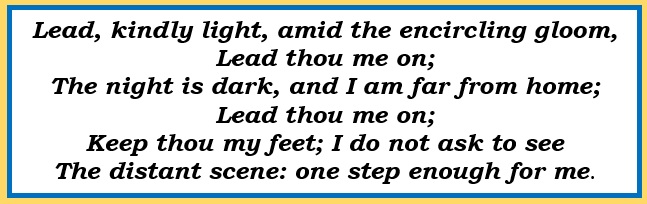
Lead Kindly Light: A Candlemas connection to an ancestor to be proud of.

“Lead Kindly Light” is not exactly on the A-List of well-known hymns, even to regular churchgoers, but it has long been well-loved by fans of choral music. The tune to which it is most commonly sung these days, Sandon, was composed by my 3x Great Grandfather Charles Henry Purday, a nineteenth century composer and musician who sang at the coronation of Queen Victoria. Purday is better remembered as a music publisher, and as a pioneer in the movement for copyright law reform, but Sandon remains as his best-known musical legacy. 

Purday's appealing melody, and the plaintive yet comforting words written by John Henry Newman at a time when he was feeling troubled and alone, make it a particularly appropriate piece for our difficult times:

However, it also works well as a title for some thoughts on Candlemas, one of many neglected or forgotten Christian festivals which could do so much to help brighten our year, especially in times like the present, which are both literally and metaphorically dark. Before moving on to that, have a listen to my Great-Great-Great Grandfather’s composition, sung here by Ely Cathedral Choir:

https://open.spotify.com/track/0UjPij2H3426yf1mj5DOpk

So, what of Candlemas? Among the many reasons why I follow and commemorate the life of Jesus of Nazareth is that doing so can give a form and pattern to our necessarily secular lives and provide opportunities for constructive reflection. Candlemas Day could be seen as a landmark in the Christian year, a moment of ending and new beginning. It falls towards the end of winter as we start to see the first signs of spring. Candlemas is a rather forgotten and neglected festival, marking the last day of the Christmas Season, and traditionally the day on which a Christmas Crib is put away, having been left in place when all the other decorations came down on 12th night. In our house, the two cribs stay defiantly in place until February 2nd.

Candlemas commemorates the Presentation of Jesus in the Temple, six weeks after his birth, as told in the Gospel of St Luke. Presentation of a child was - still is - a standard rite of passage for a Jewish child, but the story is told of an old man in the Temple, Simeon, who on seeing the infant Jesus brought for Presentation, declared that he had "seen the Light of the World",  and could now die happy. 
Simeon's words give us the Nunc Dimitis, a familiar part of the traditional Evensong. I personally find these among my favourite words from scripture, replete with meaning and comfort:-

It's easy to see how this recognition of Jesus as the "Light of the World" developed into Candlemas: a festival of light in the depths of winter is an appealing idea that long pre-dates Christianity, so the Church took it over in the same way that Christmas and Easter were "Christianised" versions of earlier festivals. What's surprising is that neither the Church nor the exploitative commercial world has ever made much of Candlemas in the way that happens with Christmas, Easter and various Saints days.

I think that's a shame. If ever there was a time of year when we need a nice little extra festival, it's surely the end of January/start of February. It's famously a depressing time of the year, with "Blue Monday" in mid-January often designated by expert psychologists as the most depressing day of the year. A case of being paid a lot of money for stating the obvious if ever there was one. So surely, we should all jump at the chance to have a little celebration at this gloomy time of the year. A bit of light in the darkness, just as Jesus was, and is, a shining light of goodness in an often dark and evil world.

In recent years, the church has adopted Christingle as a festival of light, but rather unwisely Christingle gets crammed into Advent and so gets rather caught up in the pre-Christmas busy-ness. Caught between the church's unwillingness to sing carols and celebrate during the restrained and dignified season of Advent, and a desire to anticipate the coming of the Light of the World, Christingle seems to me to be rather an incongruous intrusion in Advent, which deserves better.

So how about we start celebrating Candlemas a bit more, with or without the Christian overtones? A nice, low-key affirmation of light in the darkness of February, with perhaps a wholesome winter casserole at a candlelit table. How about a drink to celebrate the end of dry January? And as for music, well the playlist, both sacred and secular, is wonderful: Love Shine a light, Shine, Candle in the Wind, If I can Dream, Blinded by the Light, Ray of Light, any Nunc Dimitis, Lead Kindly Light, Christ is the World's true Light - even Shine Jesus Shine if you really must. There's a playlist at the bottom of this post.

It's not an original idea to mark Candlemas. It's a day steeped in folklore, derived from the idea that the end of winter may, or may not, be in sight. The Americans call it Groundhog Day - when this animal emerges from its burrow after hibernation and goes back in if it sees its own shadow - this recognises the not unreasonable idea that if the weather is sunny and settled at the start of February, there is every chance that winter will re-appear before spring finally gets going.

The same idea is present in an old English rhyme:

So keep an eye on the weather on February 2nd, and celebrate Candlemas that day, or maybe the weekend before or after. Whether as a Christian wishing to acclaim Jesus as a shining light in an often evil world, like a candle in a darkened room, or just as a welcome relief from the doom and gloom of January and a chance to keep those Easter eggs at bay, it's worth a go. Close the curtains, dim the lights, pour yourself a nice glass of red, light a candle or two, and enjoy the winter whilst looking forward to summer. 

Here's a link to my Candlemas Spotify Playlist:

https://open.spotify.com/playlist/3g8rDP7zof8M8AAgaQsxD1


Wednesday, 6 January 2021

Wake me up before you go-go (too low): FreeStyle Libre 2 comes to the NHS.

The long-awaited FreeStyle Libre 2 has arrived in the UK, and is now available on NHS prescription as a straightforward replacement for Libre 1.

It has to be said that compared to all that is going on in the world of healthcare at the dawn of 2021, this is of relatively minor importance, but it is nevertheless good for those of us living with diabetes to have a small piece of good news to greet the new year, and a welcome reminder that the NHS continues to move forward and evolve policy even in the midst of the Covid-19 Pandemic, its biggest ever challenge.

I hope that this post can answer a few questions, give everyone living with Type One Diabetes something realistic to look forward to in terms of improving their well-being, and as I have always done since becoming involved in a small way with the diabetes community, can do something to widen access to the benefits of a small but life-changing device.

A couple of formalities before I move on:

Firstly, a disclaimer: I am able to review Libre 2 at this early stage having been provided with two sensors and a reader by the manufacturers Abbott. I am one of a number of UK users to whom this opportunity has been offered, with no strings attached other than a requirement to disclose that fact. I have been part of this group since early 2015, having been one of the first in the UK to use Libre after its launch in late 2014. I was able to afford to self-fund it at the time, and as soon as I started using it, found it to be the single innovation which could most improve my life with diabetes. I wrote good things about it on social media and in a blog, and was subsequently contacted by Abbott to ask if I could feature in some promotional material, and was invited to gatherings of people with diabetes to share knowledge and opinions across different countries. We have never been asked to endorse or advertise Abbott's products. I have always been acutely aware of my good fortune, and have tried to use it to help spread the benefits of Libre as widely as possible, and that remains the case with this latest new version.

Secondly, a caution: the roll-out of Libre 2 is under way, but at a time when the NHS is under extreme pressure, and it is perfectly reasonable if HCPs are unable to prioritise requests to switch to it, or to deal with queries and concerns. If you read on, you will see that I am very positive about it, but I am at present unsure whether I will be able to get Libre 2 sensors on prescription straight away. I shall ask, but with a clear expectation that I may have to be a patient patient. Please show patience and understanding if you can't get it; it's great, but you can live without it for a few more weeks while greater needs are attended to.

So what is there to say about FreeStyle Libre 2?

Well relatively little to be honest - and that's a good thing! It's the Libre that millions around the world have grown to know and love, but with what many saw as its main weakness now addressed: it can warn you when you're going low or high. In that sense, it is much closer to a “true” CGM than Libre 1 and therefore a big step forward. And it's still free to those who meet the criteria.

The sensors look the same, come in the same familiar yellow box with a different name on, and are applied with the same applicator. Out of the box, it is impossible to distinguish a Libre 2 sensor from a Libre 1 one. Crucially, they cost the same, so no CCG or doctor should have any reason to delay or refuse a switch on cost grounds.

You don't even need a new reader if you've been using the LibreLink phone app, but if you want to use a reader, you do need to change it, and Abbott will swap it free of charge. I did ask for a reader, and will explain why later in this post...

You don't have to set the alarms, but if you don't set at least one of low or high, there seems little point in getting it at all! I set mine for low (it defaults to the widely accepted 3.9) but not high, and it worked faultlessly. On my first day using it, I started the sensor after breakfast and deliberately took my usual dose of insulin but with a bit less to eat (be careful if you do that; I was home all morning with others in the house!) Sure enough, my level fell and even though I knew it was falling both by how I felt and by a few swipes, I waited with excitement for the alarm. (I am easily amused). When it came, it was strident and persistent:

It would be hard to ignore or to sleep through it. A quick swipe in response to that prompt, and you immediately see what the problem is:-

So with some small satisfaction, on my first night wearing it, I turned off the 1:30 am alarm which had been on my phone for almost 20 years, safe in the knowledge that I would be awoken if my BG was falling, a problem from which I have on occasions suffered, and which twice in my early days with diabetes led to alarming (for my wife!!!) seizures. I am pleased to say it didn't go off, and I had a good night's sleep. 

PS - on the second night the alarm did go off, at 1:05, waking me and startling Mrs L. I had sort-of hoped it would, and accidentally-on purpose didn't have a bed-time snack as I normally do, despite a relatively low reading at that time. So another slightly risky induced low and it really has proved its worth.

So yes, in that sense, a big improvement in my diabetes management: one less hassle (that 1:30 am alarm was a minor irritant) and one less worry. FreeStyle Libre 2 will indeed Wake me up, before I go-go too low. There you go - a song title for this post, as always. Who needs an excuse to watch George Michael and Wham! at their 1984 best?

Any disadvantages?

Well basically that you still have to swipe and read to find out what the level actually is, although self-evidently if it triggers at 3.9 or whatever, that's what your level must be if you swipe immediately. The trend arrow (still in my view the most important feature of Libre) tells you whether it's falling sharply or gently, but if a low alarm sounds it would be unwise to ignore and do nothing. If you want warning before it gets that low, set it at a higher trigger level; I am always fine at 3.9 and nowhere near needing assistance at that level, but YDMV so others might wish to be warned before it gets that low.

Personally I would find high alarms annoying. Highs are not immediately threatening in the way that lows are, and I don't need a device to tell me when I'm thirsty, blurry-eyed and generally feeling like I've got a hangover without the pleasurable memory of a good night out. I may yet set up a high alarm, maybe at a level higher than I normally venture, for me maybe towards 20.

You can only have alarms on one device, the one you scan first at start-up. I use the phone app most of the time, but as I said earlier, I opted, with this first sensor, to use a reader as the alarms device. So why did I ask for a new reader?

Two things:

Firstly, I find it easier and more instant than the phone app. On my phone, getting a reading is sometimes a bit hit and miss as you try to hit the sweet spot of NFC, whereas the reader is always very quick to pick up a reading once it's near the sensor. I think the Libre 2 one is even better at this than its predecessor, but mine was getting on a bit (6 years old). In the night, I want quick and instant access, and keeping a reader by my bed makes it easy to check having barely woken up. Moreover, I resist using a phone at night. If you're not careful, whilst checking BG you see a message or breaking news notification that tempts you to open it, and before you know it, you're wide awake and fretting about something or someone. I choose to shut down my link to the outside world at bedtime and I prefer to keep it that way if possible.

Secondly, driving. I covered this aspect in a blog post once before (it's here) and it launched some debate and dissent. However, when I do resume driving further than the two miles to my local supermarket or pharmacy, I believe that Libre 2 will add another level of safety. I shall keep the reader on my dashboard where it will warn me if I have failed to recognise a falling BG level. (I might even set it at the proverbial “5 to drive”) and the same reasons why I avoid the phone at night apply even more when driving. Indeed, as I said in that previous post, to hold a phone for any reason whilst driving is illegal, whereas to hold a Libre reader isn't (it’s not an internet-connected communication device). If the alarm has gone off, a driver could check it with minimal disruption to concentration whilst driving, for example on a quiet, straight road, by pulling in if safe to do so, or dare I say on a straight and quiet motorway. No more dangerous than eating a sweet, sipping water, glancing at the SatNav, changing radio station or changing the heating temperature I believe.

Oh, and one more reason? It's a tasteful shade of blue, as opposed to the black of Libre 1:

So there you have it. Libre 2 is undoubtedly a no-brainer improvement on Libre 1, and I would assume any current user would wish to change as soon as possible. Those who fret about alleged inaccuracy and constantly compare Libre readings to finger prick tests will probably still find reason to criticise it, because it's still flash not CGM, so the same cautions about time lag between interstitial fluid and blood glucose apply. But remember BG levels move fast at times for anyone with T1D, so there will always be discrepancies - try pricking two different fingers a few seconds apart and you might get a shock at how even that can vary.

I remain a tech-sceptic diabetic: I have never really seen reason to seek pump therapy, let alone a looping add-on, as I find that the multiple daily injections that I administer (often well in excess of the basic 5) are of minimal interference with my life - barely more hassle than going to the loo. All the tech stuff seems more trouble than it's worth and often appears for some to become more of an absorption than the condition it purports to render easier to manage. I am famously not really very interested in diabetes, so ironically this makes me prefer MDI for now.

FreeStyle Libre does, however, liberate us from the biggest burden and frustrating paradox of diabetes, that inescapable reality of which I often speak: that the drug which keeps us alive is also, in day-to-day terms, a constant threat to our wellbeing. All we need to mitigate that threat is a still small voice to remind us when we are in danger.

I hope that most of those who are lucky enough to have FreeStyle Libre on prescription will experience a smooth switch to Libre 2 sooner rather than later, and in broader terms, I hope that non-invasive monitoring will rapidly supersede what already seems to me to be the archaic and messy practice of drawing blood from our fingers. Basic guidance from Abbott is here:

https://www.freestylelibre.co.uk/libre/fsl2Replacement.html

In conclusion, there are, as always, thanks and acknowledgements to be delivered:

Firstly, to the team at Abbott, who have brought to the market a device which is both valued by patients and affordable to publicly funded healthcare systems across the world. The company has been criticised when any issues occur, notably with sensor supplies, and the fact of their having a monopoly on a prescription device has been questioned, but in my experience, they have continued to listen to feedback, and to innovate and evolve the product in response to feedback. Libre 3, a refinement of 2, has been approved and is already on its way in due course.

Secondly, to HCPs who have recognised the potential value of having non-invasive monitoring available at an affordable cost to a mass market; they were led by Professor Partha Kar, OBE, who despite his constant claims to be “just doing his job” took on the task of getting Libre approved by the NHS and rattled enough cages to make it happen, driven by the interests of those whom he serves, not those for whom he works.

And finally to those patient voices who have in various ways made clear that Libre was a genuine leap forward in diabetes self-management. Libre was launched and expanded in the full glare of social media, and particularly in the early days, people only became aware of its existence through online communities. Early adopters like Laura Cleverly taught others about it through You Tube videos, and I for one first saw a Libre on the arms of friends like Abby BrownPhilippa Robilliard and Lindsay Wilson at the first GBDoc get-together in 2015. More recently, Nick Cahm did much to ensure that the NHS availability became much less of a lottery by his relentless number-crunching, and he has continued to be an authoritative voice on all matters Libre on social media.

The success of FreeStyle Libre has taught us much about the value of partnership and teamwork in healthcare. A good news story amidst very dark times.

Note: please speak to your diabetes care team in order to initiate a change to Libre 2. If you have any questions that I haven't answered, do feel free to get in touch via comments, or on social media.


Thursday, 17 December 2020

The Circle of Life - and death

This post is inspired by a poem. As far as I can tell, it's not very well-known. Have a read of it first; its relevance will become apparent if you read what follows. At the end you can click a link and see it being read by a wonderful actor, to whom I am obliquely connected. Read on....

To a poet a thousand years hence

I who am dead a thousand years,
And wrote this sweet archaic song,
Send you my words for messengers
The way I shall not pass along.

I care not if you bridge the seas,
Or ride secure the cruel sky,
Or build consummate palaces
Of metal or of masonry.

But have you wine and music still,
And statues and bright-eyed love,
And foolish thoughts of good and ill,
And prayers to them who sit above?

How shall we conquer? Like a wind
That falls at eve our fancies blow,
And old Maeonides the blind
Said it three thousand years ago.

O friend unseen, unborn, unknown,
Student of our sweet English tongue,
Read out my words at night, alone:
I was a poet, I was young.

Since I can never see your face,
And never shake you by the hand,
I send my soul through time and space
To greet you. You will understand.

James Elroy Flecker (1884-1915)

Fourteen years ago today - 18th December 2006 - was the funeral of my father, who had died on the 9th at the age of 86, after a short period of ill-health. Only hindsight imposes patterns on what at the time can seem like chaotic and distressing periods of life: my father’s death came during an extraordinarily difficult month in what proved to be a prolonged and trying few years in the lives of my family and me.

And yet even at the time I had an intangible sense that all would be well in the grander scheme of things, and that we would all emerge stronger from our trials and tribulations. Fourteen years later I was caused to re-visit the day of farewell to my father in a manner which was positive and life-affirming.

I shall not dwell on the circumstances of December 2006 in this post: the full story is known to family and close friends, but suffice it to say that the death of my father was by no means the most traumatic event of that month, but that all was well in the end, and I look back on that month with gratitude rather than sadness. Had I been on social media at the time, sharing stuff as we now do, there would have been some interesting posts, to say the least.

My father’s death came at a time when my late mother was descending into the abyss of Alzheimer’s - a story I have already shared here. On the day of the funeral my brother and I arrived at her house with our respective families, dressed in black and ready to support her through a difficult day as she said farewell to her husband of 54 years. She answered the door with a cheery smile, dressed in casual clothes and said “Oh what a lovely surprise, how nice to see you all”. It soon became apparent that she had no idea why we were there, nor that he had died, despite our having been there a couple of days earlier with the minister preparing his funeral. My wife and sister-in-law took her to her room and helped her to dress appropriately (she had always been a stickler for dressing elegantly, formally and correctly) whilst gently reminding her of what had happened and what lay ahead that day.

During that minister’s visit two days earlier, despite appearing very confused as to who he was, who we were and why we were all there, she had startled us all with a moment of lucidity by announcing that she would like to read a poem of her choice at the service, reciting some of the words from memory, quoting the title and author in such a way as to enable us easily to identify it by an online search.

The poem concerned (see above) was previously unknown to me and to any other family members, and she was unable to give any clear reason for wanting to recite it (for example she said she didn’t know whether it was a favourite of our father’s or not), but she was particularly keen on a verse which she said summed up how she felt about being widowed.

But have you wine and music still,
And statues and bright-eyed love,
And foolish thoughts of good and ill,
And prayers to them who sit above?

The poem is called To a Poet a Thousand Years Hence by James Elroy Flecker (1884-1915), a relatively unknown English poet and novelist whose premature death at 30 is said by some critics to have been a major loss to literature and poetry. My own rudimentary research reveals no reason why my mother would have known or liked his work, with no obvious connection to her other than a shared birthplace. 

Come the day of his funeral, we were all nervous that mother might make a fool of herself, not least given her intermittent lack of awareness of his death, and her growing penchant at that time for speaking out of turn in an inappropriate manner. However, she stepped up to the lectern with grace and composure, and read it perfectly, with all the same expressiveness that she had shown in her pomp as a schoolteacher and choir mistress. Sadly, this proved to be a false dawn, as she rapidly descended into an unimaginably grotesque form of dementia, lasting over six more years with little quality of life, such that her death in 2013 was a merciful release for her and us.

Life moved on as it does, and I had put the funeral and that poem to the back of my mind, regarding it as a strangely enjoyable day on which my father’s life had been suitably celebrated, with our mother showing what proved to be one of the last manifestations of her true self.

But what goes around comes around in the Circle of Life, and so fourteen years later that poem suddenly returned to my mind a couple of weeks ago in another circumstance that was desperately sad, yet became strangely uplifting. I don't believe that "everything happens for a reason", because if it does there's some pretty perverse reasoning controlling our lives. However, I do believe in being aware of possible benefits even when at first they are hard to see, such that with hindsight, even the darkest clouds can have a silver lining. For me, many events and experiences in recent years have given me good reason to believe in the existence of silver linings.

My return to thoughts of December 2006 happened because of Lis Warren, a woman of similar age to me from Middlesex who has in recent years become a good friend thanks to our shared medical condition - Type One Diabetes. Lis and I got to know each other a few years ago thanks to the growth of an online peer support community of people living with diabetes: our paths have crossed several times at events both real-world and online, and we have many mutual friends. A silver lining indeed. She and I share much more than a medical condition, and in particular we are both lovers of the arts, in particular music; she, indeed, is a musician by profession, a graduate of the Royal Academy of Music and in her working life was an advisor on music education to the Department for Education. Lis and I were two of a small group of people with diabetes and healthcare professionals who set up and ran a project called ArT1st (follow that link to the website) during the Coronavirus Pandemic, which involved gathering and showcasing artistic work in the performing and visual arts produced by members of the Type One diabetes community: patients, carers and healthcare professionals. Working with this small group, some of them already good friends of mine, others new friends, has been the silverest of linings to this locked-down year.

Tragically, as we were preparing to stage a live end-of-year online event celebrating the success of the project, Lis’s husband John died in late November after a short illness, meaning that our close-knit group felt keenly the loss of one of its members’ loved ones. We wanted to add an element to our show as a gesture to Lis, who remained determined to take part in the show, even though it turned out to be on the very day of her husband’s funeral. It was, indeed, John who had thought up the idea of calling it ArT1st with the clever play on T1. Through the good offices of NHS Specialty Advisor for Diabetes Professor Partha Kar, who had set up the project, we were able to secure the services of an A-list member of the diabetes community, actor James Norton, very much a man of the moment thanks to several starring roles in TV and cinema in recent years. James had already proved himself to be a supportive and self-effacing member of the community, and we were therefore delighted when he agreed to read a poem for us. 

But what were we to choose?

At that point To a Poet a Thousand Years Hence came back into my mind. I looked it up, to remind myself of its words, and shared my suggestion with a couple of colleagues from the group. Both colleagues readily agreed that it was perfect. Flecker’s words are both a wonderful evocation of the lasting power and value of the arts and a painful reminder that our time on this earth is short and precious. Returning to them after over a decade I was struck again by how good a choice my mother had made, whatever the forever unknown reason for that choice. I remain surprised that it is not better-known.

Flecker’s words remind us that we only tread this earth for a short time, yet what we do, what we say, what we leave behind us can indeed be eternal. Advancing years inevitably expose us to the loss of loved ones; if we are lucky, we do not experience real loss until later life, but experience it we all must. And as we age, we all start to wonder when and how our end will come, whether we will be left alone, or leave others alone, and what - if anything - lives on after our deaths.

The notion of life after death is a comforting one which sustains many and forms the basis of entire belief systems. We can never prove or refute it. However, of one thing I am more certain than ever: we absolutely do live on in what we leave to others, not in material terms, but in our deeds, our words, the personalities and values that we pass down the generations and, for a gifted few, the works of beauty that we create in art, poetry, sculpture, writings or music. A thousand years or more hence, especially now that mankind has devised such clever ways of preserving all that we produce, we will all live on. We can all now listen to music written and performed by artists long since dead, digitally preserved as fresh as the day they were recorded.

And every time I catch a look in a photo or a mirror and think “OMG, I’ve turned into my dad”, or every time I hear my own children utter words or express thoughts that I myself might have said, I realise that our earthly bodies are custodians not just of a set of genes, but more importantly of values, talents and ideas which can indeed be immortal.

“I send my soul through time and space
To greet you…You will understand”. 

Click here to watch James Norton reading this wonderful poem with the peerless expressiveness of the English gentleman that he is, dedicated to my friend Lis, her late husband John, and the diabetes community.

Note: This post was written with the knowledge and approval of Lis Warren, who has expressed her sincere and lasting gratitude for the love and support of the diabetes community during this difficult time

The Way We Were

“Can it be that it was all so simple then? Or has time re-written every line? And if we had the chance to do it all again, tell me... Would ...